
WELCOME BONUS 300%
UP TO €2000 + 100
FREE SPINS
UP TO €2000 + 100
FREE SPINS
Home → Games
Casino games at Spinz-Casino
Dozen 2:1: Twelve Numbers, One Third Coverage
Betting on a dozen in French Roulette covers twelve numbers and pays at odds of 2:1. This type of bet, alongside column bets, offers a 2:1 payout on a third of the numbers available on the wheel. The French Roulette wheel has 37 sectors, meaning a dozen bet covers exactly one-third of the playable numbers.
With a house edge of 2.70% on French Roulette, the theoretical return to player (RTP) for these bets stands at 97.30%. This is a standard figure for European-style wheels where the edge is derived from the single zero pocket. Unlike some other variants, the La Partage rule does not apply to these inside bets.
A €10 bet on a dozen, if successful, returns €20 in profit plus the original stake. This payout structure is consistent across dozen and column bets. Players should note that this bet type does not contribute towards bonus wagering requirements, as table games generally contribute only 10%.
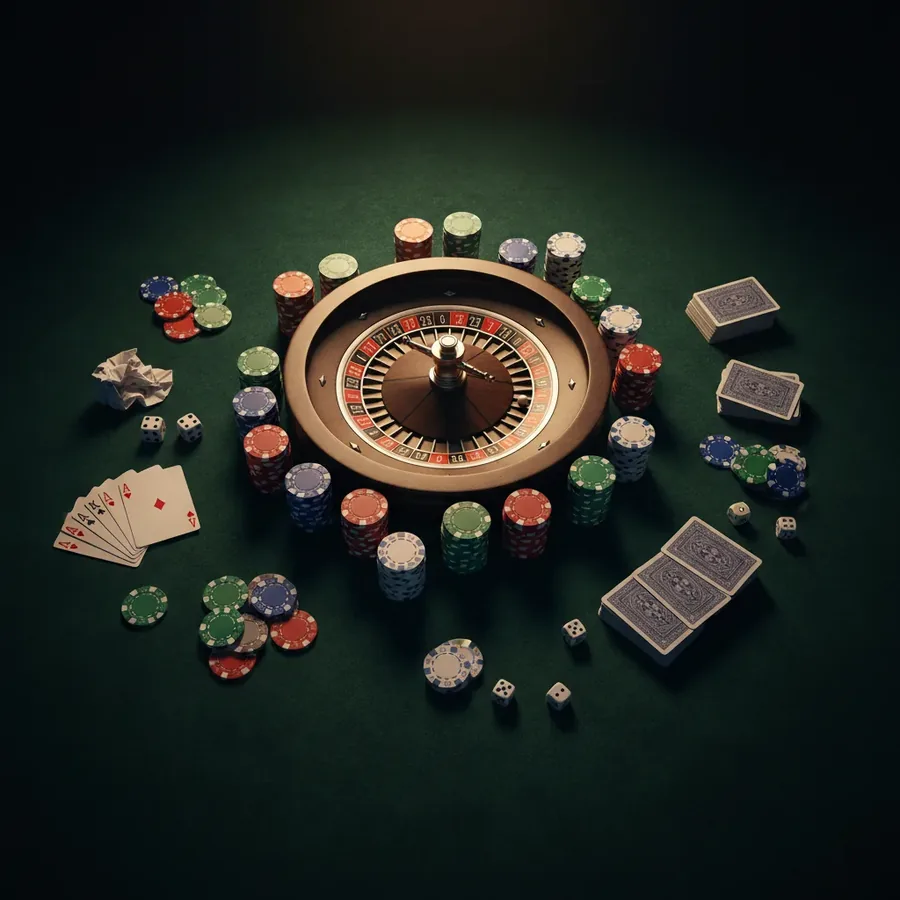
Soft 17: the Ace counts 11 or 1
In Blackjack, a 'Soft 17' hand refers to a hand containing an Ace, which can be valued as either 11 or 1. This flexibility allows players to hit or stand without immediately busting, as the Ace can adapt its value. The dealer hitting on a Soft 17 is a common rule variation that impacts the house edge.
When the dealer hits on a Soft 17, it increases the house edge by approximately 0.22 percentage points compared to a dealer standing on all 17s. This means the theoretical RTP is slightly lower in such scenarios. For example, a game where the dealer stands on Soft 17 might offer a higher RTP.
Understanding this rule is crucial for players aiming to optimise their play, particularly when considering game variations. A liberal Vegas Strip rule set, which includes the dealer standing on Soft 17, offers a favourable house edge of 0.28%. This contrasts with games where the dealer hits Soft 17, potentially increasing the casino's advantage.
Roulette Wheel with 37 vs 38 Pockets
The fundamental difference between European and American Roulette lies in the number of pockets on the wheel. European Roulette features 37 pockets, including numbers 1-36 and a single zero (0). This single zero is the primary factor contributing to the lower house edge found on these wheels.
American Roulette wheels, conversely, have 38 pockets, incorporating numbers 1-36, a single zero (0), and a double zero (00). This additional pocket significantly increases the house edge to 5.26%, compared to the 2.70% found on European wheels. Despite the extra pocket, payout odds for single number bets remain at 35:1.
This distinction directly affects the player's theoretical return. The RTP for American Roulette is 94.74%, whereas European Roulette offers a higher RTP of 97.30%. The Five Number Bet on American Roulette is particularly disadvantageous, carrying a house edge of 7.89% due to its coverage of only five out of 38 sectors.
When is Splitting Aces and Eights Sensible?
Splitting Aces is generally a favourable move in Blackjack, as it gives the player two chances to achieve a strong hand, often starting with an 11. When Aces are split, each Ace is typically dealt one additional card, forming two new hands. This strategy can significantly improve the player's odds.
Splitting eights is also a recommended strategy in many Blackjack variations, especially when the dealer's upcard is weak. A hand totaling 16 (two eights) is a very poor starting point, and splitting them into two hands of eight provides a better opportunity to build more competitive totals.
The rule variations in Blackjack can influence the sensibility of these splits. For instance, doubling after a split (DAS) can make splitting more advantageous. In games with liberal rules like the Liberal Vegas Strip variant (RTP 99.72%), where DAS is allowed, splitting Aces and eights becomes even more strategically sound.
Video Poker: check payout table before betting
Before engaging in Video Poker, it is imperative to consult the payout table, as it dictates the return to player (RTP) and the house edge. A prime example is Jacks or Better, where the '9/6' Full Pay version offers an RTP of 99.54% with a house edge of 0.46%.
Variations in payout tables can dramatically alter the game's profitability. For instance, Jacks or Better 8/5, which pays 8 coins for a Full House and 5 for a Flush, has a significantly lower RTP of 97.29% and a house edge of 2.71%. This reduction in payout for key hands directly increases the casino's advantage.
The maximum bet in Video Poker, typically five coins, is often required to qualify for the highest bonus payouts, such as the Royal Flush bonus. For the 9/6 Jacks or Better, betting five coins for a Royal Flush yields 4000 coins, whereas a standard bet might only pay 800 coins. This highlights the importance of understanding the full payout structure.
Game categories at a glance
| Category | Examples | Stakes From | Highlight |
|---|---|---|---|
| Slots | Major Millions, Gonzo's Quest, Immortal Romance | 0,10 EUR | thousands of titles |
| Table games | Roulette, Blackjack, Baccarat | 0,50 EUR | classic rules |
| Live casino | Blackjack Party, Dream Catcher | 0,20 EUR | real dealers |
| Jackpot games | Mega Moolah, Divine Fortune, Age of the Gods | 0,20 EUR | progressive pools |
| Instant games | Aviator, Plinko, Mines | 0,10 EUR | fast rounds |
| Video poker | Jacks or Better, Deuces Wild | 0,25 EUR | strategy based |
Straight, Split, and Corner: Three Terms Briefly Explained
In French Roulette, a Straight bet on a single number offers a payout of 35:1. This bet covers one sector of the wheel, with the house edge on these inner bets remaining at 2.70% as La Partage does not apply. This means for every 37 units wagered on a single number, 36 are returned on a win, and 1 is retained by the casino on average.
A Split bet, covering two adjacent numbers, pays 17:1. This bet also falls under the 2.70% house edge for French Roulette inner bets, as the wheel structure and lack of La Partage for inner wagers maintain the European edge. For instance, a €10 Split bet would return €170 plus the original €10 if successful.
The Corner bet, covering four numbers, yields a payout of 8:1. Similar to other inner bets in French Roulette without La Partage, the house edge remains at 2.70%. A successful €10 Corner bet would result in a payout of €80 plus the initial stake.
Straight 35:1 Instead of 36:1: Where House Edge Originates
The Straight bet in Roulette, paying 35:1, is a fundamental element contributing to the game's house edge. While seemingly offering a high return, the payout is structured such that it accounts for the casino's advantage. For a European Roulette wheel with 37 sectors, a true payout would be 36:1.
The discrepancy between the true payout of 36:1 and the offered 35:1 for a Straight bet on a 37-sector wheel creates the house edge. This difference of one unit per 37 effectively translates to a 2.70% house advantage on this bet. This is a consistent factor across many Roulette variants.
This mechanism ensures that over a vast number of spins, the casino expects to retain 2.70% of all wagers placed on single numbers. For example, if €100 is wagered on a single number across many rounds, approximately €2.70 is expected to be kept by the casino in the long run.
Connection Lost in Table Game: Round Continues Automatically
In certain table games, an unstable internet connection will not interrupt the game flow. If a player's connection drops during a round, the game will continue automatically based on the last valid input. This ensures that bets are still processed and outcomes are determined as if the player were actively participating.
This automatic continuation is particularly relevant in games like Blackjack, where decisions need to be made promptly. The system will proceed with the game according to established rules or the player's pre-set preferences if no further input is received. This maintains fairness and prevents players from missing out on potential wins or incurring unnecessary losses.
For instance, in a Blackjack hand where a player has not made a decision on hitting or standing, the game will automatically follow the dealer's rules, typically hitting on a soft 17. This process ensures that the round concludes even without active player input, with the outcome reflecting the game's standard operations.
House Edge and RTP: Two Names for the Same Number
The House Edge and the Return to Player (RTP) are two sides of the same coin, representing the casino's mathematical advantage and the player's theoretical long-term return, respectively. A house edge of 2.70% in French Roulette directly corresponds to an RTP of 97.30%. This RTP is calculated as 100% minus the house edge.
For example, in Blackjack with specific rules, a house edge of 0.28% means that the RTP is 99.72%. This figure indicates that, over an extensive period and a very large number of wagers, players can expect to receive 99.72% of their total money back, with the remaining 0.28% being the casino's profit.
Understanding both terms is crucial for players. An RTP of 99.54% in Video Poker Jacks or Better 9/6 signifies a house edge of 0.46%. This high RTP suggests a favourable game for players when played with optimal strategy, as the casino's long-term retention is minimal.
How Long Does a Roulette Round Take on Average?
The duration of a single Roulette round is typically very short, often lasting only a matter of seconds. This speed is due to the automated nature of online Roulette, where the spinning wheel and ball simulation are processed rapidly by the game's software. For example, a French Roulette round can conclude in approximately 15-20 seconds.
The time for a Roulette round is largely consistent across different bet types within the same variant. Whether a player wagers on an inside bet like a Straight or an outside bet like Red/Black, the spin and result determination happen in a similar timeframe. This allows for a high volume of gameplay.
While the spin itself is quick, the total time spent per round might slightly increase with betting actions and potential confirmation steps. However, the core gameplay loop from bet placement to result is designed for efficiency, allowing for potentially hundreds of rounds within an hour, depending on player speed.
Keno and Bingo with RTP Between 92 and 95
Keno and Bingo games offer a theoretical return to player (RTP) that typically falls within the 92% to 95% range. For example, certain Keno variants might present an RTP of 92.11%, indicating a house edge of 7.89%. This means that, on average, for every 100 units wagered, the player can expect to receive 92.11 units back over an extended period.
When considering a specific wager, such as the Five Number Bet in American Roulette, which has an RTP of 92.11%, the house advantage is substantial. This particular bet covers five sectors out of 38 on the wheel, and the payout is 6:1. This bet is notable for having an edge exceeding the standard 5.26% found on the rest of the American wheel.
The consequence for a player engaging with these games is a higher inherent cost compared to other casino offerings. For instance, if a player were to bet 100 EUR on a game with a 92.11% RTP, the expected loss over time would be 7.89 EUR. This figure underscores the importance of understanding game mathematics before wagering.
Craps: Pass Line plus Odds lowers the average
The Pass Line bet in Craps, combined with taking Odds, significantly reduces the overall house advantage. The Pass Line bet itself has an RTP of 98.59%, resulting in a house edge of 1.41%. When Odds are added, which are bets that pay according to true odds, the house edge on the combined wager can be further diminished.
For example, by strategically placing additional bets on Odds after a point has been established, players can achieve a combined RTP of 99.63% with a house edge of just 0.37% under a 3-4-5x odds system. This means that for every 100 EUR wagered on the Pass Line with these Odds, the expected return to the player is 99.63 EUR.
This combination of bets provides a more favorable mathematical proposition for the player. A 100 EUR bet across 50 rounds, considering the combined RTP of 99.63%, would result in an expected value of 99.63 EUR per 100 EUR wagered, significantly lowering the average loss compared to bets without Odds.
Variance at the Table: 1:1 vs. 35:1
The payout ratios for different bets in casino games illustrate varying levels of variance, with 1:1 bets representing low variance and 35:1 bets indicating high variance. For example, a Straight bet in Roulette pays 35:1, meaning a 1 EUR bet could yield 35 EUR in profit. This is contrasted with a 1:1 payout, where a 1 EUR bet returns 1 EUR profit.
In American Roulette, the house edge is 5.26% on most bets, including the Straight bet which pays 35:1. This means that while the potential payout is high, the probability of winning such a bet is lower, contributing to its high variance. The RTP for American Roulette is 94.74%.
For a player betting 100 EUR on 50 rounds, the difference in variance is substantial. A series of 1:1 bets would lead to more frequent but smaller wins and losses, averaging out closer to the RTP. Conversely, high-variance bets like the 35:1 Straight bet can result in significant swings, with the possibility of large wins but also a higher chance of consecutive losses.
100 EUR bet, 50 rounds: the expected value
Calculating the expected value for 50 rounds of betting 100 EUR requires knowledge of the specific game's RTP. For instance, if a game offers an RTP of 98.15%, as seen in Blackjack with a 6:5 payout, the expected value per 100 EUR bet over 50 rounds can be determined.
With an RTP of 98.15%, the house edge is 1.85%. For a 100 EUR bet across 50 rounds, the total wagered amount is 5,000 EUR (100 EUR x 50 rounds). The expected return to the player is 98.15% of this total, meaning 4,907.50 EUR (5,000 EUR x 0.9815).
Therefore, the expected value, representing the average outcome over many repetitions, for 50 rounds of 100 EUR bets on a game with 98.15% RTP is a net loss of 92.50 EUR (5,000 EUR - 4,907.50 EUR). This calculation highlights the long-term mathematical disadvantage players face.
Before Double Down: read the open dealer card
Strategic decisions in Blackjack, such as when to Double Down, are heavily influenced by the dealer's upcard. This maneuver allows a player to double their bet in exchange for receiving only one more card, making it crucial to assess the dealer's potential hand strength.
For example, in Blackjack with liberal Vegas Strip rules and a 3:2 payout, the RTP is 99.72% with a house edge of 0.28%. This combination includes favorable rules like Surrender, which should be considered in conjunction with the dealer's visible card.
Understanding these rules and the dealer's card allows players to make informed choices. Deciding whether to Double Down, Hit, Stand, or Split based on the dealer's open card and the player's hand can significantly impact the overall RTP and the expected value of the session.
Contact
Live - online chat
Banking









Providers












Spinz Casino 2026